

Albania Part 3: Bazaars, Castles, and a Dessert I’ll Never Forget
- Tricia Kampert
- Sep 21, 2025
- 9 min read

The next morning, we all gathered in the hotel lobby, luggage in hand, ready to check out for good. There would be no return after our trek to Krujë. From there, we’d go straight to the airport and back to Valcamonica.
Outside, our ever-patient tour guide, who had shepherded us through every twist and turn of this trip, stood waiting with the van. Today’s destination, he promised, was the most magical spot in all of Albania. And even though the drive was long, it never felt tedious. The scenery outside the window held me captive. Albania isn’t quite first world, but it’s not third world either; it lingers somewhere in between, a fascinating in-between that was written in every small town we passed and every glimpse of everyday life along the way.
A Hilltop Restaurant with the Best View of Krujë


When we finally reached Krujë, I stepped out in my denim jumpsuit and heeled boots, entirely oblivious to the footwear choices of my companions (every one of them in sensible trekking shoes). We parked in a small parking garage and walked 2 minutes to a restaurant that held a view of Krujë we never expected to see. From its terrace, Krujë spilled out before us in a sweep of stone and sky with the coastline far off in the distance, but seemingly so close. Inside, the warmth was immediate, not just from the heat, but from the waiters who greeted us as if they’d been expecting us for weeks. The place was dressed for Christmas with every corner glowing with festive reds, golds, and greens.
We nestled ourselves in a corner which was surrounded by a huge wall of windows where we were able to see the castle directly above us on top of the mountain. We ordered hot chocolates and teas, thawing our fingers around steaming mugs, until one friend broke the spell. He looked at my shoes, then back at me.“Why are you wearing heels? You do know we have to climb stone paths up to the castle… right?”
My blank stare was answer enough. Thankfully, my trekking boots were in my suitcase… in the van. Our driver, the saint that he is, walked me back so I could change. Suddenly, everyone’s footwear made perfect sense.
On the way, I struck up a conversation with the other driver who had joined us for the day. When he learned I was American, his face lit up. His family, it turned out, lived in Chicago. In that brief exchange, the vastness of the world felt smaller, warmer. Right then we felt a human connection, the kind of unexpected connection you only stumble upon in travel, and that somehow feels just as important as the sights themselves, maybe even more-so.
Exploring Krujë Bazaar: Handwoven Carpets, Flags, and Local Treasures


With my footwear crisis resolved, we set off toward the castle. The path wound through Krujë’s Old Bazaar, a cobbled artery lined with wooden storefronts that looked as though they’d been lifted from another century. Stalls spilled over with handwoven carpets in deep reds and indigos, copper coffee sets that caught the winter light, and shelves stacked with carved wooden eagles, Albania’s national symbol, watching over everything with silent pride. The air was a blend of history and commerce with a faint sweetness of conversation made by the locals as we passed by. I made sure to mark in my mind where I can buy my Albanian flag. As we all know, that’s my one and only souvenir I cannot leave any country without.
The climb began in earnest as we left the market behind. The stone path tilted upward, each uneven step holding memories of centuries passed. These were not tourist-friendly steps designed for comfort; these were the original bones of the fortress road, shaped by the boots of soldiers and the hooves of warhorses. Somewhere up ahead, beyond the modern-day chatter of visitors, I imagined the clang of steel, the rallying cries of men defending their homeland.
Krujë Castle History: Home of Skanderbeg and Albanian Resistance


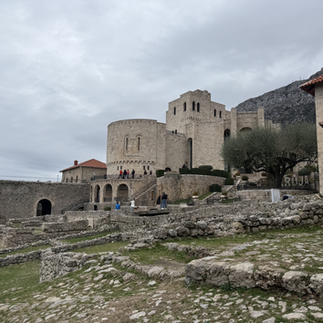
Krujë Castle emerged slowly, like a sentinel materializing from the fog of history. Perched high above the valley, its walls still carried the defiant spirit of Skanderbeg, the warrior who turned this fortress into the beating heart of Albanian resistance against the Ottoman Empire. Inside these ramparts, strategies had been plotted by firelight; from these towers, lookouts once scanned the horizon for the enemy’s approach.
As we reached the top, the view spread out in a breathtaking panorama… a tapestry of green valleys, red-tiled roofs, and the distant shimmer of the Adriatic Sea. The wind was sharper here, the sky somehow bigger, and for a moment, time folded in on itself. You could almost believe that the sentries never left, that the castle still stands ready for battle.
Stepping inside Krujë Castle was like crossing a threshold in time. This was not the kind of “here’s a nice ruin, take your photo” time travel, but the kind time travel that drags you into the marrow of history and makes you feel it.
The first stretch was open air, a wide courtyard framed by crumbling walls that had seen more winters than any living soul here. The stones underfoot were polished smooth by centuries of footsteps: defenders, messengers, the occasional spy slipping through under cover of darkness. To the left, the skeleton of old dwellings clung to the hillside, their foundations hinting at lives lived in the shadow of war.
Once past the ramparts, the ruins opened like a labyrinth, each turn revealing another fragment of the fortress’s soul. Roofless chambers stood like broken teeth against the winter sky, their walls etched with the faint scars of fire and siege. Narrow corridors funneled us into rooms that once throbbed with purpose: barracks where soldiers slept in their armor, storerooms where grain was rationed, council halls where war was plotted over maps by flickering torchlight.
Interactive Exhibits That Bring Krujë Castle’s Past to Life


In many of these spaces, modern technology breathed life back into the stone. Standing in a cold, empty room, we could watch a screen flicker to life or even put on a pair of goggles providing us with a completely immersive experience, pulling us backward through centuries. With each projection, the space around us shifted: a bare stone hall became a bustling command center; a crumbling chamber transformed into a candlelit gathering place for Skanderbeg’s men. The smells and sounds were left to the imagination, but the sights alone were enough to make the past press in around us.
One room showed the armory in its prime: racks of spears and swords lined against the walls, polished shields catching the firelight. Another revealed the inner court, where civilians and soldiers mingled, tradesmen hawked goods, and messengers dashed in with urgent news from the front. The technology let us stand in the very spot where history was made and see it happen again.
We moved slowly, almost reverently, from room to room. Each display seemed to hold us in place just a little longer than the last, as if the castle itself was reluctant to let us leave. At times, I caught myself touching the stone, half to steady myself on the uneven ground, half to connect with the countless hands that had braced against it before me.
By the time we reached the upper terraces, where the wind whipped mercilessly and the view spilled over the valley, I felt as though I’d been walking alongside those who had once lived, fought, and died here. Krujë Castle wasn’t just a relic to be admired from afar. It was a living memory… a memory which we had stepped inside to explore for a few hours, like Dumbledore’s pensieve.
Then came the museum, the Skanderbeg Museum, a modern structure, yes, but heavy with reverence. Inside, the light was low, the air still. Glass cases displayed swords so long they looked forged for giants, their blades dulled not by neglect but by the countless strikes they had endured. There were Ottoman banners captured in battle, frayed and faded yet still exuding a kind of stubborn dignity. Armor sat on display, empty but somehow not lifeless, as if the warriors had simply stepped out for a moment and might return to reclaim it.
Every wall told the same story: here stood Gjergj Kastrioti, Skanderbeg, Albania’s lionhearted defender who turned this fortress into an unbreakable shield. For over two decades, this hilltop stronghold defied the vast Ottoman Empire, its banners snapping in the mountain wind like a challenge.
Past the museum, narrow stone passages twisted like veins through the heart of the castle. Some opened to sweeping views over the bazaar and the valley beyond; others led to abrupt drops where walls had fallen away, leaving the skeleton of the fortress bare against the sky. From one vantage point, the land spilled away in every direction; fertile valleys, distant peaks, and somewhere beyond the horizon, the restless Adriatic. It was the exact view a commander surely would have studied daily, scanning for enemy movements… or perhaps the kind of view that made a man fight harder to protect what lay below.
In the far reaches, the ruins grew quieter, the stone colder. Here, moss clung stubbornly to the walls, and the wind carried a sharper edge. It was easy to imagine the echo of armored footsteps, the bark of orders, the sudden clash of steel in the air. If you have a vivid imagination, this was the kind of imagining that would make you glance over your shoulder, half-expecting to find a soldier watching you wondering if you are friend or foe.
Standing there, the noise of modern life fell away. No cars. No chatter. Only the heartbeat of the wind and the weight of history pressing down not to crush you, but to remind you that this place was never meant for the faint-hearted.
We wound our way back down through the bazaar, the cobblestones still slick from the morning’s chill. This time, I stopped at a small stall I’d been eyeing on the way up. Hanging from the wooden beams was the Albanian flag I didn’t know I’d been waiting for: handmade, handwoven, rich crimson with the double-headed eagle stitched in deep black. It was bold, striking, and unapologetically Albanian. Of all the flags I’ve collected in my travels, this one instantly became my favorite. It was a piece of the country I could take home and keep locked away from the memories I created here.
Traditional Albanian Feast After Visiting Krujë Castle

From there, we returned to the same restaurant we had visited that morning, now transformed from a cozy refuge into a royal banquet. A long table had been set for all sixteen of us, laden with dishes that could have fed an army! They presented us with roasted meats, fresh bread still warm from the oven, vegetables steeped in olive oil, and platters that seemed to replenish themselves no matter how much we ate, giving The Great Hall vibes and me having no regrets having seconds and thirds. We dined like kings and queens (or Gryffindors and Hufflepuffs), laughter rolling as freely as the wine.
Trying Kabuni: Albania’s Most Unique Dessert

Then came dessert.
It arrived in small, unassuming bowls: a base of rice, topped with sugar, and crowned, unexpectedly, with delicate strands of meat surrounded by fruits. This, we were told, was Kabuni, a traditional Albanian dish that walks the fine line between savory and sweet. The rice is simmered in mutton broth, perfumed with cinnamon and cloves, and often enriched with raisins, a centuries-old recipe meant to be both comforting and celebratory.
I took a cautious bite. Sweetness first, then the slow, creeping wave of savory that felt… misplaced. The texture of the meat’s fine “nerves” wove through each mouthful like an uninvited guest at a holiday party. It was without question the most unusual dessert I have ever tried, and as my brain tried to make sense of it, my stomach politely suggested I stop.
Still, I finished the bite. Because that’s the unspoken rule of travel… you try the thing, even if the thing tries you back.
Departing Albania Through Tirana Airport at Christmas
With full stomachs and bags packed, we climbed back into the van for the final leg of our journey. Krujë’s stone walls and winding bazaar faded into the distance, the valley unfolding below like a painted tapestry. The ride to the airport felt quieter, as if we all knew the trip was reaching its final chapter and were reluctant to turn the page.

When we arrived, the airport was dressed for the season: garlands wrapped around the railings, wreaths hung with glints of gold and crimson, and a towering Christmas tree that seemed to spill light into every corner of the terminal. For a moment, it didn’t feel like a place of departure at all, but a grand hall prepared for a holiday gathering.
We wheeled our suitcases beneath twinkling lights, the air filled with the scent of cinnamon from a nearby café. And while the festive glow couldn’t erase the bittersweet pull of leaving, it softened it, as though Albania itself was offering a warm, decorated farewell.
Somewhere between the security line and the boarding gate, I glanced back one last time. Not at the terminal, but at the memory of everything beyond it: the fortress walls, the winding streets, the stubborn spirit of a country that had welcomed us like old friends. And then, with the last call for our flight echoing overhead, we stepped forward, carrying Albania with us in our suitcases, our stories, and the threads of a crimson flag



Comments